
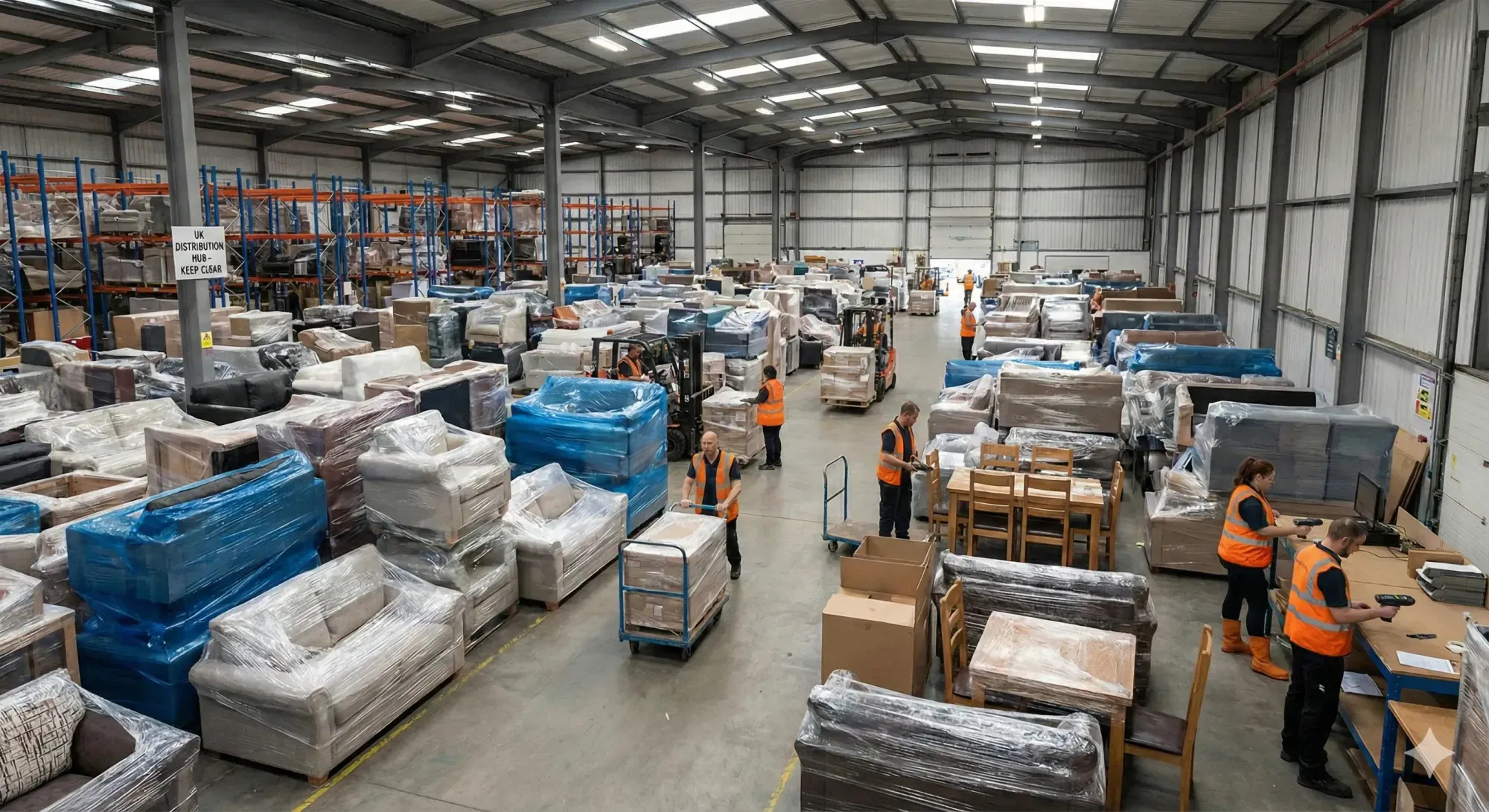
Warehouse Management Systems: What Retailers Need to Know
A warehouse management system (WMS) is the software that records where every item sits in a warehouse, from the moment it is scanned in, to the moment it leaves on a van.
For furniture and appliance retailers, the real test goes beyond the feature list. A sofa can ship in three boxes. A fridge freezer needs two people and a clear route to the kitchen. A returned bed frame has to be checked and graded before it can be sold again. The system has to hold all of that, then pass the right details to the crew making the delivery.
For many retailers, the bigger decision is whether to run a WMS at all, or use a 3PL whose system already tracks the stock and gives them live access to it.
Warehouse Management Systems (WMS) at a Glance
A WMS controls stock inside the warehouse. For bulky goods, its value also depends on what it passes on to delivery and returns.
What Is a Warehouse Management System?
A warehouse management system (WMS) is software that records every stock movement inside a warehouse by location, and directs the work of receiving, storing, picking, packing, dispatch and returns.
An inventory management system tells you how many units you have. A WMS tells you which bay they are in, which order they belong to and what needs to happen to them next.
Retailers often run several systems side by side, and each one answers a different question.
Which WMS Features Matter Most for Retailers?
The most important Warehouse Management System (WMS) features for retailers are real-time inventory tracking, automation, forecasting, multi-channel integration, and returns management. These features help retailers reduce stock errors, prevent overselling, speed up order fulfilment and improve customer satisfaction.
Real-Time Stock Tracking
Real-time stock tracking means every movement is scanned as it happens, at goods-in, putaway, picking, dispatch and returns. The result is one live stock figure that every sales channel draws from. Miss a scan and the record drifts, which shows up later as orders for stock that is not on the shelf.
Multichannel Order and Stock Sync
If you sell through your own website, Amazon, eBay and a showroom, every channel needs to draw from the same stock pool. An ecommerce fulfilment system connected to those channels updates availability as orders arrive, which stops two customers buying the last sofa.
V1's API integration connects to Amazon Seller Central, eBay and Shopify for two-way order sync and real-time inventory updates, so orders reach the warehouse without manual data entry.
AI Demand Forecasting
AI forecasting uses sales history, seasonality and promotions to suggest how much to reorder and when.
Warehouse Automation
For most retailers, warehouse automation starts with barcode scanners, mobile devices, system-directed pick routes and bulk label printing, not robots. Robotic picking suits high volumes of small, uniform items. Sofas, wardrobes and washing machines still need people and handling equipment, so the system's job is to send those people to the right place with the right instructions.
Returns Management
Large items can come back after delivery. In a December 2025 survey of 1,500 UK furniture buyers by retail technology provider Fixtuur, 23% said they had returned large furniture in the previous two years.
A WMS should record why each item came back and grade its condition. Stock that can be resold goes back on sale quickly, and damaged stock is repaired, recycled or written off.
What Does a WMS Need to Tell the Delivery Crew?
For bulky goods, the warehouse system's job does not end at dispatch. It needs to pass the crew enough detail to finish the delivery in one visit.
Access is where many large-item deliveries go wrong. In the same Fixtuur survey, 49% of UK furniture buyers said they had ordered an item that did not fit through the door or up the stairs. A crew that knows about a narrow staircase before it sets off can plan the route, bring the right equipment or call ahead.
Good furniture warehouse technology carries these details with the order.
How Should a WMS Handle Orders That Ship in Several Boxes?
Treat the set as one unit. Each box should be scanned against the order before loading, and the order should only show as dispatched once every box is on the van. Box-level status also tells customer service which part of an order is where if a customer calls.
How Should Delivery Proof Feed Back Into Stock and Returns?
A photo and a signature should close the order in the same system that holds the stock record. If the customer reports damage, that evidence needs to reach the returns process without anyone re-keying it.
At V1, every delivery shows as completed on the portal once a photo of the delivered product and the customer's signature are uploaded. For high-value items, condition is also documented with photos at pickup and at delivery.
Can a WMS Reduce Warehouse Costs and Speed Up Fulfilment?
It can, mainly by reducing the work of picking. A 2025 study in the journal Applied Sciences puts order picking at 50 to 75% of total warehouse operating costs. Shorter pick routes, batch picking and fewer picking errors therefore have the biggest effect on cost.
Speed comes from fewer delays between stages. In V1's analysis of 1,455 deliveries for Furniture Direct Online, V1 averaged 1.73 days from stock receipt to delivery and delivered 92% of orders within three days.
Do Retailers Need Their Own WMS If They Use a 3PL?
Usually not. If a 3PL stores and ships your stock, its WMS already records every movement. What you need is live access to that data, a reliable link to your sales channels and the right to take your records with you if you leave.
There is no universal order volume at which outsourcing makes sense. The Prowess guide points to signs such as dispatch delays at peak and stock taking over space you need for other work.
V1's Warehousing Solutions run storage, stock control and two-man delivery as one operation from the West Midlands. Goods are scanned into V1's warehouse management system on arrival, and both you and your customer can track each order to the door.
What Should You Ask a 3PL About Its Warehouse Management System?
These seven questions cover the basics and the bulky-goods details most retailers forget to ask.
- Which WMS do you use, and can I export my data if I leave? Stock, order and returns history should come with you in a usable format.
- How often do you count stock, and how do you report accuracy? Ask how the figure is calculated as well as what it is.
- Which sales channels do you connect to, and how often does stock update? Overselling starts with slow or one-way sync.
- How do you track an order that ships in several boxes? Look for box-level scanning against the order.
- What handling and access details reach the delivery crew? Two-person lifts, stairs and parking should be on the job sheet before loading.
- How do photos, signatures and damage notes reach me? You need them for customer service and claims.
- How are returns graded, and what happens to items that can be resold? The answer decides how much value you recover.
Key Takeaways
- A WMS records stock by location and directs warehouse work, which an inventory system alone does not do.
- For furniture and appliances, test how a system or your 3PL handles multi-box orders, access details and returns grading.
- Cloud suits most retailers. Check that any older system can still connect to your channels and delivery partners.
- If a 3PL runs your warehouse, you need live data access and a way to take your records with you, not your own WMS.
Warehousing and Delivery With V1 Distribution
V1 Distribution stores, tracks and delivers furniture, appliances and other bulky goods for UK retailers from its West Midlands base. Our warehousing connects stock control to two-man delivery, so the details a crew needs travel with the order.
The operation handles up to three times its routine daily order volume at peak and runs at a 98% on-time delivery rate. Returns are collected in the same three-hour windows as deliveries, with the same live tracking.
Explore our Warehousing Solutions and speak to V1 Distribution about how your orders would move from goods-in to the customer's door.
Frequently Asked Questions
What Happens to My Stock Data If I Change 3PL?
That depends on the contract, so agree it before signing. Confirm that you can export stock levels, order history, and returns records in a standard format, and that the provider keeps your data for how long after you leave.
What Should Retailers Look for When Choosing a 3PL Warehousing and Delivery Partner?
Retailers should choose a 3PL partner that offers real-time inventory visibility, reliable ecommerce integrations, accurate order fulfilment, secure warehousing and delivery services suited to their products. For furniture and appliance retailers, experience in bulky-goods handling, two-person delivery, returns management and proof of delivery is particularly important. V1 Distribution brings these services together, helping UK retailers simplify logistics and maintain visibility from warehouse storage through to final delivery.
Why Is a Specialist 3PL Important for Furniture and Appliance Retailers?
A specialist 3PL is important for furniture and appliance retailers because bulky, heavy and high-value products require more than standard parcel fulfilment. Warehousing and delivery operations must account for product dimensions, multi-box orders, careful handling, two-person delivery and property access requirements. V1 Distribution combines specialist bulky-goods warehousing with two-person delivery, helping retailers reduce handling complications and provide a more reliable customer experience.
Do I Need My Own Warehouse Management System If I Partner With a 3PL?
No, most retailers do not need their own Warehouse Management System (WMS) when partnering with a third-party logistics (3PL) provider. A 3PL manages stock tracking, warehouse operations and order fulfilment through its own WMS, giving retailers access to inventory and order information without investing in separate warehouse software. With V1 Distribution, retailers can benefit from integrated warehousing, real-time stock visibility and specialist delivery services through one logistics partnership.
How Does 3PL Reduce Transit Damage Rates?
3PL and Warehouse Management Systems (WMS) help retailers reduce transit damage by minimising unnecessary transportation and handling. At V1, imported goods can be delivered directly to our warehouse instead of travelling to a retailer’s warehouse before collection. Fewer road miles and handling stages reduce the risk of transit damage, helping retailers protect stock, lower costs and improve supply chain efficiency.